Engineers Recruiting
Engineers
“As in other aspects of the war, it is gratifying to note that Australia does not lag behind
in her contributions of engineering units to the combatant forces of the world. A visit
to the principal training camp for engineers of the Australian Imperial Forces,
situated at Moore Park, will show how splendidly Australian mechanics and Australian
engineers have responded to the call of Empire. Here, at Moore Park, and at Centennial
Park -where what might be called the "parades" of practical engineering, active service
Work is done-may be seen abundant evidence of Australia's activity in war engineering.

ALL PICKED MEN.
Under the command of Colonel Spain, V.D., the engineers' camp is an object lesson of
thorough training, and of that most valuable of all military assets, perhaps, esprit de corps
among the troops. Captain A. J. Arnot is the camp adjutant, and Lieutenant "Jock" Calder, chief instructor, with Lieutenant E. A. Cottee as quarter-master. On the other side of the fence, in the Sydney Cricket Ground enclosure, is the camp of the engineers officers' school of instruction,
under Lieutenant (Professor) Nadsen , assistant professor of electrical engineering at the
Sydney University. The staff consists of eight or nine officers, all of whom are men well known
in the engineering profession of the Commonwealth, and all of whom, also, have left lucrative
and honoured callings in civil life in answer to the call of Empire, to instruct Australian recruits
to this most important branch of the Empire's arms.
Every one of these recruits, too, is a picked man. None but proficient mechanics-artisans in the truest sense of the word-have a chance of being attached to the Australian Engineers. Of skilled carpenters there are a large number. Then plumbers, builders, bricklayers, ironworkers, and last,
but not least, electrical students. With a corps of such men, led by such officers, it is not difficult
to understand that a fine spirit of comradeship and a high standard of discipline reigns. These
men are more than soldiers-they are engineers. Included in their equipment is that of the infantryman-rifle, bayonet, etc. But there is much other equipment, of which too much must not
be said.
It will be sufficient, perhaps, to say that the Australian Engineers have distinguished themselves,
and earned unstinted praise from General Sir Ian Hamilton. It is to follow in the footsteps of these
that Colonel Spain's men are training most assiduously at Moore Park. They tackle their work with avidity, and that work is of intense interest to watch.
BRIDGE BUILDING.
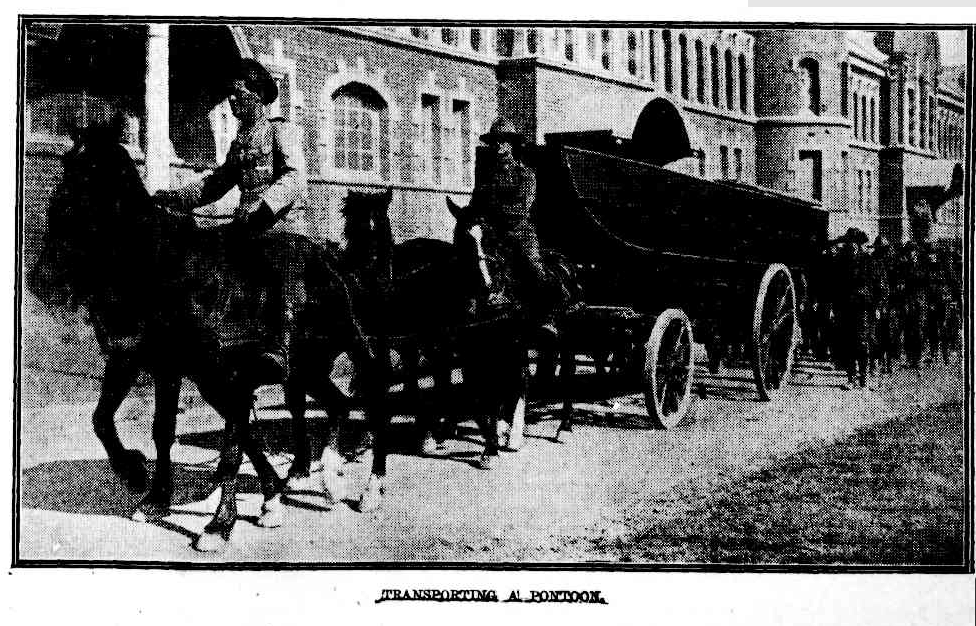
Bridge building is by no means the only work, but it ranks among the chief. “Pontoon and barrel bridges" – the words are simple, every-day expressions-but they mean much in the warfare of the present day. A pontoon bridge, the uninitiated might be informed, is a bridge built on pontoons, or flat-bottomed boats.
Pontoons are part of the equipment, and are carried in the big waggons of the corps. But pontoons are expensive, and take time to construct. Barrels are brought into much more frequent use on active service.
"We use barrels whenever we have them," said Colonel Spain, "and when we haven't got them handy and somebody else has-well, we simply commandeer the barrels."

The layman is astounded at the simplicity -and the rapidity-of the construction of these bridges. No nails, bolts, spikes, or other iron implements are used. Everything is done with barrels (or pontoons), heavy timber spars, and ropes. Here one finds a detachment of men learning to tie a knot. No
"grandmother's knots" about these. These knots and slings demonstrate the art of mechanism.
One was privileged to see a bridge completed, thrown across a lake in Centennial Park, and loaded. It had a span of 75 feet. It was built by 42 men in half an hour! "But won't it sink?" asks the layman-and these engineers laugh. Then you are told that this simple bridge, built of timber and rope,
in half an hour, will carry a load of 500lb -per foot run of the bridge until further orders.
Bridge-building, handling tools, trench work is the curriculum, in brief, of the engineers.
A SURPRISE ATTACK.
A week or two ago these engineering recruits carried out valuable manoeuvres under
active service conditions. By the kindness of Miss Edith Walker, they were enabled to
shift camp for a few days to that lady's land at Concord West. The sandy nature of the
Moore Park camp grounds is anything but suitable for trench work, but at Concord West
the conditions were practically ideal. Here the men could dig service trenches under service
conditions, and the change was of great benefit. Miss Walker also allowed much of the
standing timber to be cut down, and so the bridge-building work was also practised
under service conditions. The men slept in the open, with their blankets and rifles by their side.
Here an interesting sham fight took place. The defending force consisted of 45 men.
Quite unknown to these, a force of 180 men left Moore Park about midnight one night,
and trained to Concord. Then an attack was carried out. The men were armed with rifles,
and supplied with 10 rounds of blank ammunition apiece. Two sorties were made. But
the "school" of 45 was not taken by surprise. They had made active service preparations
for an attack. In lieu of searchlights they had arranged bon-fires on a large scale around
their camp. Upon the sentries sounding the alarm, these bon fires were lit by pickets
posted close by, and at once the attacking force of 180 men found itself
brilliantly silhouetted in the glare, and the attack was beaten off. It was valuable training.
A FINISHING COURSE.
Colonel Spain explained that this camp is constantly receiving units from the other States,
who come to Moore Park for the finishing course of their training. The importance of the
camp is therefore apparent. Nearly all the engineer recruits are drawn from the infantry
units of the other camps, and they, therefore, receive the double training which makes
of them, when they reinforce their colleages (sic) at the front, both soldiers and engineers.
Last week a route march was held in Centennial Park, and the corps made an imposing
picture.
This (Wednesday) afternoon, the men are to hold a sports meeting on the Cricket Ground
in aid of the engineers' recreation fund. Mainly owing to the exertions of Mrs. F.
W. Hughes-a prominent figure at the daily "pie parade" at Victoria Barracks-the engineers
now have a band of 18 performers. Hearing of the efforts to get funds to purchase
instruments, Mrs Hughes busied herself, and the necessary funds were now available.
On Monday last the band played at a mess luncheon in the camp, to which the "pie
parade" ladies had been invited. These artisans showed that they were not novices at
music, and the band is now quite a feature of the camp.
The Camp Commandant has introduced a scheme into the camp this week to prevent
petty pilfering from the luggage of the troops, which has occurred occasionally while the
men were on leave. A baggage office has now been set apart, and notices are posted up
that if the troops when going on leave will deposit their baggage at the office they are
given a check ticket, and their belongings are looked after till their return.
The casualties amongst the engineers have been enormous in this war. They are always
up at the front, and their work is pre-eminently dangerous. But Australian reinforcements
are going forward regularly. Colonel Spain stated that there is no difficulty in getting
all the men they want from time to time. Australian artisans are rallying well to the
call to arms, and when the history of the war is written there is no doubt their work will
be fully appreciated.”
“The latest orders for munitions for the British Government, aggregating £16,000,000,
have just been sent to manufacturing firms in various parts of Canada. No fewer than
151 cities and towns are now working on those munitions, and for several months from
£2,400,000 to £3,000,000 has been paid out in wages, etc.”
National Library of Australia http://nla.gov.au/nla.news-article15649398
Sydney Morning Herald (NSW : 1842 - 1954), Wednesday 23 February 1916, page 7