Malibar Mobilisation
Camps
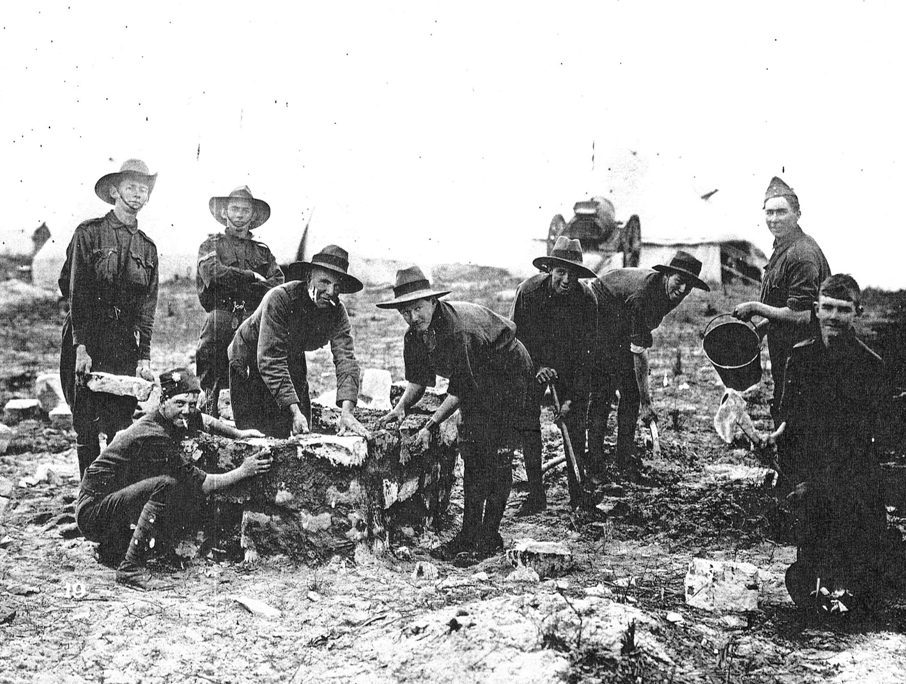
The Long Bay Rifle Range was used for musketry practice during the First World War.
The Range site had been set aside for general military purposes in 1910, and the site was used as a training and shooting ground by several battalions. On 27 August 1914, five officers and five Non-Commissioned Officers associated with the 3rd Battalion attended a musketry course at Randwick Rifle Range.
It was intended that these officers could impart their knowledge to the rest of the Infantry Battalion. On 14 September, the battalion, consisting of 991 men and 32 officers, “marched out for the first time to the heath overlooking the sea at Maroubra”.(1)
The battalion, under the command of Major A. J. Bennett, marched from the Randwick Racecourse, where the men were stationed during their period of training, along what is now called Anzac Parade to Long Bay, together with several wagons of equipment, eleven horses and two Maxim machine guns, issued to each battalion stop.
The range site was used for general exercises during the War and, along with Randwick Rifle Range, as a musketry range, although no permanent butts were in place stop only a few years later, however, plans were drawn up and work commenced on the Long Bay Rifle Range, a permanent shooting complex that was to serve the Army for nearly seventy years. The Range was used to train servicemen for the First and Second World Wars, as well as later conflicts, including Korea and Vietnam.”
From the Official History of Australia in the War of 1914- 191 8, written by C.E. W. Bean (Volume I, p83).
Source - A History of the Anzac Rifle Range Malabar (Chapter 4) by Nathan Scudder -Edited by Matthew Moses. Printed with permission of Graham Crowe, Deputy Chairman, NSW Rifle Association Inc. 2019.
The Long Bay Rifle Range at Malabar was renamed the ANZAC Rifle Range by the Army in 1970 to commemorate the Australian Rifle Club members who served during the two World Wars and the Korean Campaign. The National Rifle Association records show that as of 31 December 1916, 6486 members of the NSW Rifle Clubs had enlisted for active service during WWI. The total number of Australian Rifle Club members who enlisted for WWII is believed to be between 33,000 and 38,000. The "Memorial Gates" are dedicated to the "Fallen Riflemen” of these wars.
https://en.wikipedia.org/wiki/ANZAC_Rifle_Range#ANZAC_Memorial_Gates