Men Wanted For Wireless Corps
Engineers
“The men who are being trained as operators for war service — many of them had no knowledge of the work before— should find no difficulty later on in securing good positions at their new profession, for the supply of trained men has never been equal to the demand, and war developments will make the demand greater than ever when the world again settles down to peace conditions. “
The following sketch was written by a young Sydney businessman who recently responded to the call for recruits for the Wireless Corps. More men are needed for that unit — operators, mechanics, fitters, harness makers, motor cyclists, and others. The application form on this page may be used by anyone desirous of enlisting in this branch of the Engineers.
I MADE up my mind recently that the time had come when I must offer my services to my country . Having a good deal of technical knowledge, I decided that the Engineers or the Artillery would suit me best, but before joining up I paid a visit to several of the camps just to get an idea of the kind of work done in the training areas. The field that attracted me most was the Wireless Section of the Engineers.
On arrival at the depot at Moore Park 1 was cordially invited to “have a look round.” First I went to the lecture-room, where a troop of 30 or 40 students, note-books and pencils in hand,
were listening attentively to a sergeant, who was explaining the theory of wireless telegraphy.
The blackboard diagrams of the various electrical circuits, etc., looked intricate and mysterious.
1 was informed that all the wire less instructors were men who had gone through the highest
university and technical training, and were now giving their best to assist others to take their part efficiently in their country's interest. The students, I felt, were exceedingly lucky in receiving such a thorough training. On glancing at the syllabus of lectures I was amazed at the high standard of the course set out. At the other end of the hall at least 50 enthusiastic students were seated with telephone receivers to their , ears, rapidly writing down messages being sent by operators at the head of each table. This is called “buzzer practice”, and I should think it is. The transmitting keys, cells, and telephone receivers are connected up with these “buzzers”, and each time the key is pressed the buzzers give forth a musical note similar to that received on wireless stations. On
placing a telephone receiver to my ear I listened attentively to the message — a meaningless and confusing succession of noises, which conveyed to me just as much signification as a dozen or so blowflies would when enclosed in a pickle bottle. The manipulation of the transmitter key, I found to my surprise, was not so easy as it appeared.
The students are tested periodically, and their sending and receiving rates and efficiency duly recorded. AS I passed through the men's mess I was struck by the cleanliness and general appearance of the tables and floor. Out in the verandah students were busily engaged with spanners and screwdrivers, assembling and dissembling engines and electrical generators. Some students
were attentively sketching intricate parts and pondering over their action when in the machine; others were tracing out the windings of the armature, field coils, etc. At one end of the verandah we found engines dismantled — gear wheels, screws, piston rings, sparking plugs, valves, and tappets, all in a heap — ready for the student to assemble, and in doing so he has to know the reason for,
and adjustment of, every part. I guessed that by the time I had assembled the engine I would have had sufficient parts left over for a second engine. Groups of students around engines were endeavouring to trace out faults, and as I heard them discussing the probable trouble I soon realised that what they did not know about engines was not necessary for them to Know. There was a limited
time for these faults to be found, and each student had to ensure that his engine was in first-class working condition.
A BRIEF visit to the storeroom was quite sufficient — place for everything and everything in its place. There were pack saddles neatly arranged in rows, engines, wireless station sets, flags, field telephone sets, heliograph sets, and so on. The corporal here unfurled their prized and beautiful flag of purple and silver, and while I was admiring it informed me that the silver zig-zag of lightning
represented “W. Toc. Esses” — in other words, 'Wireless Training School”. The instrument-repairing work shop proved very interesting. Students were intently engaged repairing even the most delicate electrical instruments, and I was keenly interested in seeing the internal arrangements of one of the wireless receiving sets — just one mass of wires and coils of wire. The mechanic commenced to explain. “Here is the receiving jigger primary,” he said, “and this is the Belli condenser; this is the aerial tuning inductance” — and then he looked at me and, noticing a very puzzled expression on my face, stopped short, and I passed on. The old “Zoo” proved an interesting place, for the stables were situated here. The officer in charge and the sergeant are both returned soldiers. The desert, one of
them declared, is the place where only good horsemen, energetic and resourceful, enterprising, hard riders, and daredevils need apply. Out in Centennial Park we came across a flag-signalling station, with a signaller in charge. The other members were the reader, writer, and answerer, all busily engaged in their work. As I looked through the telescope I could just distinguish the movement of a tiny flag some eight miles distant. Nearby was another party of men with a heliograph, and by the aid of the sun they were flashing instructions from headquarters to another station somewhere on the Blue Mountains, about 60 miles away. In the distance we watched many of the boys busy at
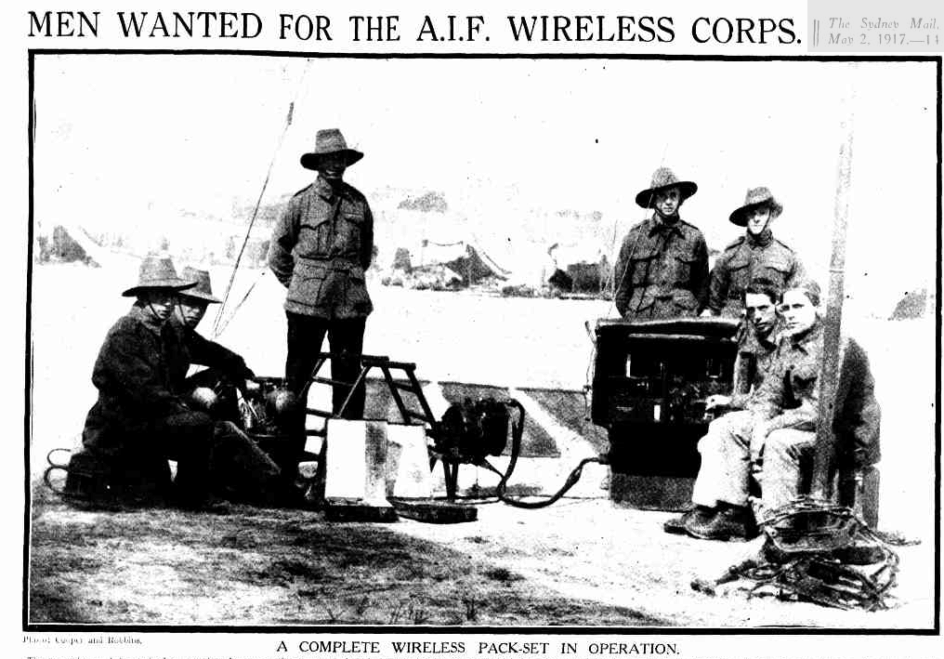
troop drill; so we moved on in that direction. They approached at the trot as a troop in line, forty horses abreast, and, as the riding master shouted a sharp command, “Sections Right!” the troop turned smartly together, and trotted off in another direction in sections of fours. Without doubt, I thought, the saddle is the place where our brave Australian boys feel at home. A place where our brave Australian boys feel at home. They revel in it. But I cannot ride. Over the brow of a hill two mounted parties, each composed of 13 men, quickly approached. They were engaged in a competition for fastest time in complete wireless station erection. This pack wireless station is carried by four horses — the leading horse carrying the aerial, the second horse the instruments, the third loaded with the masts, and the fourth with the engine and generator. As soon as the whistle was blown the men sprang from their saddles, and within a few minutes the steel masts , which are 30ft high, and aerials simply flew into position, and all were adjusted, and the stations were in action within fifteen minutes. Then followed the roaring of the exhaust of the engines and the crackling of vivid electrical oscillatory discharges as the operator calmly called up the distant station bivouacked in the Blue Mountains; and a few seconds later we received their answer. I took my hat off, and, placing the double telephone receiver to my ears, listened intently to the buzz, buzz, buzz. “That is a message from a steamer far out at sea,” I was told. A few minutes later I listened to another message. “That is Port Darwin calling up Melbourne,” said the operator. “This engine, you
see, is coupled to the generator, and the latter generates the necessary electrical energy, which is transformed by this box of apparatus, called the transmitter, to a very high voltage and very high frequency. The energy is induced in the aerial circuit, and transmitted to all parts of the globe at the enormous velocity of 300,000,000 metres a second, or seven and a half times around the world in a second.” “I suppose you haven't the slightest difficulty in getting suitable men to fill the vacant places in your unit?” I queried. “Well, we can do with all we can get,” said the operator, “for we have many calls to meet. We have to supply reinforcements to so many different units. There are the First Division of Signallers in France, the Cavalry Divisional Signal Squadron and the Wireless
Squadron in Mesopotamia, and the First Divisional Signalling Squadron attached to the Anzac Mounted Division in Egypt. Operators and mechanics also have to be specially selected for the Australian Flying Corps.” “What qualifications must a man possess before you will accept him for your unit?” I asked, “We need trained wireless operators, telegraphists, telephone and cable men, telegraph linesmen, instrument mechanics, fitters and repairers, drivers, harness- makers, despatch riders, motor cyclists, etc. It is our aim, as far as possible, to so place our men that they may carry on their civil occupation in their military work.”
Then there must be one of those departments I can fill Successfully,” I said. “Sign me on.”
“Good man,” said the officer in charge. “We could do with a few score men; only want them soon, for the training takes some time to complete, and unless they come up at the double now their chances of doing things will be gone. The war is not going to last so much longer, you know.”
And he stretched out his hand and received me into the wireless fraternity.
Sydney Mail (NSW : 1912 - 1938), Wednesday 2 May 1917, page 14 (1-5)
National Library of Australia http://nla.gov.au/nla.news-article160387133